
Pentatonic Elevator Triangles: Connect the Five Boxes
Eyup FretHeads! If you feel stuck in box 1, or clumsy shifting from one pentatonic box to the next, this lesson gives you three tiny landmarks that make the move easy.
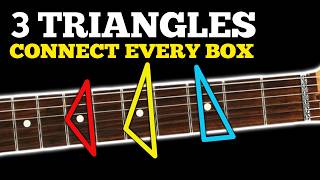
| Box 1 | Scalene | G string 7, B string 5 and 8 |
| Box 2 | Isosceles | G string 9, B string 8 and 10 |
| Box 3 | Scalene | G string 12, B string 10 and 13 |
| Box 4 | Isosceles | G string 14, B string 13 and 15 |
| Box 5 | Right angled | G string 17, B string 15 and 17 |
Step 1: Use the awkward string pair
I always talk about the guitar in string pairs. The E and A, D and G, and B and E pairs are tuned a perfect 4th apart, but the G and B strings are tuned a Major 3rd apart. That little monkey is why changing scale positions can feel awkward. Instead of fighting it, we leverage it, because that odd tuning is exactly what creates the pentatonic elevator triangles.
Step 2: Meet the three triangles
There are three shapes. People kindly corrected my geometry on the original video, so here are the proper names. The scalene triangle has no equal sides. The isosceles triangle looks evenly sided on a chart. The right angled triangle has two of its notes on the same fret. Each one is just three notes across the G and B strings, so they are quick to learn.
Step 3: Find the scalene triangle in box 1
Play A minor pentatonic box 1 at the 5th fret, then take only the notes on the G and B strings. Drop the lower G string note and keep the 7th fret, with the 5th and 8th frets on the B string. That is the scalene triangle, and it lives inside your pentatonic. You probably know it already from those fast hammer on and pull off licks with a bend at the 7th fret.
Step 4: Follow the sequence up the neck
Move up into box 2 and the G and B notes give you an isosceles triangle. Box 3 gives you another scalene, exactly the same shape as box 1, and box 4 another isosceles. Box 5 uses the one we have not had yet, the right angled triangle. Slide up from there and you land back on the box 1 scalene: scalene, isosceles, scalene, isosceles, right angled.
Step 5: Use the triangles to bridge licks
Remember frets 3, 5, 7 and 9 are just octaves of 15, 17, 19 and 21, so if you learn it all down low you have learnt it up the dusty end of the neck too. Now take a lick low down and another lick higher up, like a unison bend in box 4. Ride the elevator triangles between them and you get that effect of running up the neck.
How to practise this
Play each triangle on its own first, saying its name as you go. Then join two at a time, box 1 into box 2, until the move feels automatic. Finally, play a short lick in box 1, ride the triangles up to box 4, and finish with a lick there.
Free tool: Metronome. Keep each triangle move steady and in time as you join one box to the next.
Common questions
What are pentatonic elevator triangles?
They are three note shapes on the G and B strings, taken from each pentatonic box, that act as landmarks for moving from one box into the next.
Why are the G and B strings different?
Every other neighbouring pair is tuned a perfect 4th apart, but G to B is a Major 3rd, so scale shapes shift by one fret when they cross those strings.
How do I get out of pentatonic box 1?
Find a landmark inside box 1 that connects to box 2, such as the triangle on the G and B strings, and slide from it into the matching shape in the next box.
Do the triangles work in other keys?
Yes. The shapes are movable, so once you find box 1 in any minor key the same triangle sequence follows from there.

Get my free practice booklet
What to practise, in what order, and how to build a routine that works for you.
Keep learning

More ways to practise

Printable worksheets and matching ad free videos. Download, print and keep them beside you while you practise.
Explore PDF Club
The fretting hand techniques that make your playing sound musical, not stiff or mechanical.
Learn more
100 pages of blank chord boxes for writing, practising and teaching guitar.
Get your copy
Write, play and share your tabs, with playback so you can hear what you've written. Affiliate link.
Check it outWant my free Guitar Practice Made Simple booklet?
Know what to practise and make every session count. I'll send it straight to your inbox.
No spam. Unsubscribe any time.