
An Easier Way to Play Barre Chords: Scout, Shape, Bar
Eyup FretHeads! Most people are taught to put the index finger barre on first, then struggle to squeeze the other fingers in. That works against the way your hand is built, and there's an easier order.
| Scout | Middle finger | Goes on first and finds the chord |
| Shape | Ring and little fingers | Go on together as a two finger group |
| Bar | Index finger | Goes on last, like a capo |
Step 1: Understand the machine
Everybody's hands are different, but they all work the same way. Tendons run along each finger: extensors on the back, flexors underneath, pulling against each other like strings. Small bands called the junctura tendinum link the extensors, and sagittal bands keep your knuckles in place. When you put the barre on first and then stretch the other fingers, you're working against both of them, which is why it feels awful.
Step 2: Send in the scout
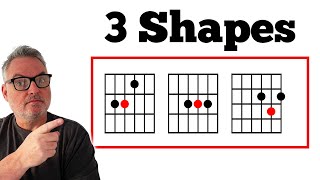
Take the E shape, the barre chord you'll use most, for your F and your B. Switch your fingers round so the index is free, then move the whole shape up. Your middle finger goes on first. I call it the scout. It's called the middle finger because it's the middle of your hand, and that's where the balance comes from.
Step 3: Add the shape as one finger
Your ring and little fingers want to work together, so put them on at the same time as a two finger group. Every step you take out of the process makes you quicker at changing chords. For a minor E shape, the two finger group does the scouting itself. A minor at the 5th fret: two fingers on, then reach for the barre.
Step 4: Put the bar on last
Now lay your index finger across like a capo, or a new nut. Because the shape is already in place, the barre can move more than you think. Focus your pressure on the strings that actually sound in the barre. If your middle finger has nothing to do, rest it next to your index like a two finger Kit Kat and let it help push down.
Step 5: Thumb and the bottle cap method
Keep your thumb pointing up at about 12 o'clock, or 11 at most, so your palm isn't clasping the back of the neck. Then think of a bottle opener: two forces working against each other. Push your strumming arm into the body of the guitar and pull the neck gently towards you. That adds pressure to the barre, so your thumb doesn't have to squeeze.
How to practise this
Say scout, shape, bar out loud as you place each part of an E shaped barre chord, then take your hand off and repeat at another fret. Do the same with the E minor shape, scouting with the two finger group. To build strength, barre all six strings high up the neck and pick each string one at a time until they all ring clear.
Free tool: Metronome. Set a slow click and place scout, shape and bar on successive beats, then speed up as the order becomes automatic.
Common questions
Why are barre chords so hard?
Usually because the barre goes on first, which forces you to stretch the other fingers against the tendons and bands that link them. Placing the barre last removes most of that tension.
Which finger should go down first on a barre chord?
I lead with the middle finger, then add the ring and little fingers together, and put the index finger barre on last.
Where should my thumb go for barre chords?
Behind the neck, pointing up at roughly 12 o'clock, so there is space between your palm and the neck.
Why do some strings buzz in my barre?
They often fall into the creases of your index finger. Roll the finger slightly onto its harder outside edge and focus pressure on the strings that actually sound in the barre.

Get my free practice booklet
What to practise, in what order, and how to build a routine that works for you.
Keep learning


More ways to practise

Printable worksheets and matching ad free videos. Download, print and keep them beside you while you practise.
Explore PDF Club
The fretting hand techniques that make your playing sound musical, not stiff or mechanical.
Learn more
100 pages of blank chord boxes for writing, practising and teaching guitar.
Get your copy
Write, play and share your tabs, with playback so you can hear what you've written. Affiliate link.
Check it outWant my free Guitar Practice Made Simple booklet?
Know what to practise and make every session count. I'll send it straight to your inbox.
No spam. Unsubscribe any time.