
The Three Major Triad Shapes and Their Inversions
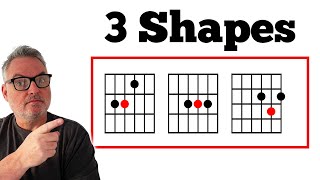
Eyup FretHeads! The word triads puts a lot of people off, and some books throw dozens of patterns at you. Really there are only three shapes to learn, and you probably know one of them already.
| Root position | R 3 5 | Minor: R ♭3 5 |
| First inversion | 3 5 R | Minor: ♭3 5 R |
| Second inversion | 5 R 3 | Minor: 5 R ♭3 |
Step 1: You already know 5 R 3
Put your fingers on an E chord. The three fretted notes are the 5th, the root and the 3rd. Do the same with an A chord and a D chord and you get the same pattern: 5 R 3. That's a triad, three notes, like a tripod or a triceratops. The C chord stacks them the other way, root, 3rd, 5th, a bit like a barbershop quartet.
Step 2: Three orders, three shapes
Those three notes can only go in three orders. R 3 5 is root position. 3 5 R, with the 3rd in the bass, is first inversion. 5 R 3 is second inversion. If the guitar had more strings, the pattern would just keep going 5 R 3 5 R 3. Learn these three master shapes and move them around on different groups of three strings, which I call string sets.
Step 3: Play smaller chords instead of barres
If an A barre chord is a struggle, play the first inversion on the A, D and G strings: 4th fret on the A string, 2nd fret on the D and G strings. That's C♯, E and A, the same A Major chord. It has a warmer, Hendrix style sound. Think like a piano player, who plays a chord with three fingers. A guitar chord doesn't need six strings.
Step 4: Flatten the 3rd for minor
Find the 3rd in any shape and lower it by one fret. That turns R 3 5 into R ♭3 5, and 5 R 3 into 5 R ♭3. The other two notes stay put. Major is happy, minor is sad... it's the duality of life. Take that A first inversion, drop the A string note to the 3rd fret, and you have A minor.
Step 5: Use triads in your solos
Over a chord, the triad notes are your safe notes. Over A minor, I'd say don't go for the root first, go for an emotion note like the ♭3. Try A minor on the D, G and B strings: C at the 10th fret of the D string, E at the 9th of the G string, A at the 10th of the B string. Join the shapes up and you're playing arpeggios.
How to practise this
Pick one chord, say A Major, and find all three Major triad shapes on one string set. Then lower each 3rd by one fret to find the A minor shapes. When that feels easy, choose another root note or another string set and repeat.
Free tool: Quick Tab Maker. Write out the three triad shapes on each string set so you have your own reference sheet.
Common questions
What is a triad on guitar?
A three note chord made of a root, a 3rd and a 5th. A Major triad has a Major 3rd and a minor triad has a minor 3rd.
How many triad shapes are there?
Three for each chord type on a given string set: root position, first inversion and second inversion. They repeat across every set of three neighbouring strings, adjusted for the G to B tuning.
What is the difference between a Major and minor triad?
Only the 3rd. Lower the Major 3rd by one fret to get a minor 3rd and the chord becomes minor.
Why use triads instead of full chords?
They are easier to play than barre chords, they cut through a band without clashing, and they show you the chord tones to target when you solo.

Get my free practice booklet
What to practise, in what order, and how to build a routine that works for you.
Keep learning


More ways to practise

Printable worksheets and matching ad free videos. Download, print and keep them beside you while you practise.
Explore PDF Club
The fretting hand techniques that make your playing sound musical, not stiff or mechanical.
Learn more
100 pages of blank chord boxes for writing, practising and teaching guitar.
Get your copy
Write, play and share your tabs, with playback so you can hear what you've written. Affiliate link.
Check it outWant my free Guitar Practice Made Simple booklet?
Know what to practise and make every session count. I'll send it straight to your inbox.
No spam. Unsubscribe any time.