
Play Chords All Over the Neck with the L7 Grid
Eyup FretHeads! Knowing your chords in one spot is fine until the song needs them somewhere else. With a bit of fretboard maths and the L7 Grid you can find every main chord in a key all over the neck.
| Next string, same pitch | Subtract 5 | C at low E 8th fret to A string 3rd fret |
| Next string, octave higher | Add 7 | C at low E 8th fret to A string 15th fret |
| G to B, same pitch | Subtract 4 | C at G string 5th fret to B string 1st fret |
| G to B, octave higher | Add 8 | C at G string 5th fret to B string 13th fret |
Step 1: Use fretboard maths, not counting
Don't count frets. To find the same note on the next string towards the thin E, subtract 5: the C at the 8th fret of the low E is also at the 3rd fret of the A string. If you're too low to subtract, add 7 instead and you get the same note an octave higher. Across the G and B strings, subtract 4 or add 8, because of the one fret compensation.
Step 2: Build the L7 Grid in C
C on the 8th fret of the low E string is chord I, an E shape. Chord IV, F, is on the same fret of the A string as an A shape, and chord V, G, is two frets higher. That's 1 4 5, your Majors. The minors, 6 3 2, form the opposite L: A minor at the 12th fret of the A string, E minor at the 12th of the low E and D minor at the 10th.
Step 3: Move the grid with string pairs
E and A, D and G, and B and E are the three perfect 4th string pairs, and A and D behaves the same way. Anything you play on one pair works on the others. Use minus 5 to drop the grid onto the A and D strings: now chord I is an A shape at the 3rd fret, and chords IV and V become D shapes you can slim down to 5 R 3 triads.
Step 4: Strip chords down to dyads
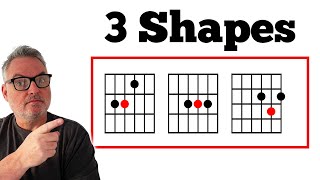
The smallest chord is just the root and the 3rd, a dyad. Build an E shape, take away everything but the root and the 3rd, and move it through 1 4 5. Flatten the 3rd by one fret and you get the minors, 6 3 2. Root and 3rd is Major, root and ♭3 is minor. Tiny chords like these leave plenty of space in a band.
Step 5: Expand into 7ths and shells
Now build back up: dyad, triad, 7th chord, shell chord, then extensions. In a Major key, I and IV are Major 7, ii, iii and vi are minor 7 and V is dominant 7. A shell chord keeps the root, 3rd and 7th and drops the 5th, which adds the least colour. Play the whole grid as shells and hear how each string pair changes the timbre.
How to practise this
Pick a key, find its tonic on the low E string and place the 1 4 5 6 3 2 grid around it. Play the progression as full chords, then triads, then root and 3rd dyads, then 7th chords and shell chords. Finally use minus 5 to move the whole grid onto the next string pair and do it again.
Free tool: Fretboard Note Trainer. Get fast at naming the tonic on any string, so you can drop the grid into place without counting.
Common questions
How do you find the same note on the next string?
Subtract 5 from the fret number, or subtract 4 when crossing from the G string to the B string.
What is a dyad on guitar?
A two note chord. Root and Major 3rd sounds Major, root and minor 3rd sounds minor.
What is a shell chord?
A chord reduced to the root, 3rd and 7th. The 5th is left out because it adds the least colour.
What are the 7th chords in a Major key?
Major 7 on I and IV, minor 7 on ii, iii and vi, dominant 7 on V and half diminished on vii.

Get my free practice booklet
What to practise, in what order, and how to build a routine that works for you.
Keep learning


More ways to practise

Printable worksheets and matching ad free videos. Download, print and keep them beside you while you practise.
Explore PDF Club
The fretting hand techniques that make your playing sound musical, not stiff or mechanical.
Learn more
100 pages of blank chord boxes for writing, practising and teaching guitar.
Get your copy
Write, play and share your tabs, with playback so you can hear what you've written. Affiliate link.
Check it outWant my free Guitar Practice Made Simple booklet?
Know what to practise and make every session count. I'll send it straight to your inbox.
No spam. Unsubscribe any time.