
Play One Major Chord in All Five CAGED Shapes
Eyup FretHeads! If you can play the open C, A, G, E and D chords, you already know the CAGED shapes. You just don't know where to look for them up the neck yet, and this drill fixes that.
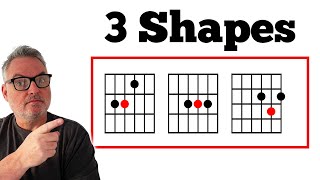
| C shape | Root on the A string, 3rd fret | The open C chord |
| A shape | Root on the A string, 3rd fret | Barre at the 3rd fret |
| G shape | Root on the low E string, 8th fret | Play the inside four strings as a first inversion |
| E shape | Root on the low E string, 8th fret | E shaped barre at the 8th fret |
| D shape | Root on the D string, 10th fret | Use a three or four note first inversion |
Step 1: The one chord rule
Choose one Major chord and stick with it the whole time. If you pick C Major, you play C Major in every position. You're only changing the shape and the place on the neck, never the chord. That one rule removes the overwhelm and turns CAGED into a map. I call it the one chord five places drill.
Step 2: Don't fight awkward shapes
I don't care how many strings you play. Three notes is fine, four notes is fine, it just has to be the same chord. Start with the open C shape, then the A shape barred at the 3rd fret. As you play each one, say the chord name, look at it, listen to it, then pause and think about what you noticed before moving on.
Step 3: G shape and E shape
The full G shape is tricky, so leave out the E strings. Keep part of the A shape and add the note from the G shape, playing the inside four strings. You're starting on the 3rd, which makes it a first inversion, a bit richer and very pretty. The E shape shares that root on the low E string, so play a good old fashioned barre chord at the 8th fret.
Step 4: D shape and back to the start
The D shape uses four strings and can be awkward as a full grip. Move the note from the thin E string onto the thick E string and you get another first inversion. You can skinny it down to just three notes. After the D shape you're at the 12th fret, so the whole cycle starts again with the C shape.
Step 5: Point to the root first
Before you play each shape, point to the root note and name it. Then play the chord and say it. That connects four things at once: the shape you see, the sound you hear, the grip you feel and where the chord lives on the neck. Then try another chord. E Major starts on the open E shape and goes E, D, C, A, G and back to E.
How to practise this
Use my two minute rule: pick one Major chord and spend two minutes moving it through all five CAGED positions, pointing to the root before each shape. Do it every day with a different chord. Two minutes is easy to find, and feeling you don't have time is usually what stops you getting started.
Free tool: Fretboard Note Trainer. Find the root notes quickly on the low E, A and D strings so you know where each CAGED shape starts.
Common questions
What is the CAGED system?
It is a way of seeing any chord in five movable shapes based on the open C, A, G, E and D chords, which link up along the neck.
What order do the CAGED shapes go in?
Always C, A, G, E, D and round again. You can start anywhere in the cycle, so E Major goes E, D, C, A, G.
Do I have to play full barre chords for CAGED?
No. Three or four note partial shapes work fine as long as they contain the notes of the chord.
Why do CAGED shapes repeat at the 12th fret?
The 12th fret is an octave above the open strings, so the same chord shapes and positions start again from there.

Get my free practice booklet
What to practise, in what order, and how to build a routine that works for you.
Keep learning


More ways to practise

Printable worksheets and matching ad free videos. Download, print and keep them beside you while you practise.
Explore PDF Club
The fretting hand techniques that make your playing sound musical, not stiff or mechanical.
Learn more
100 pages of blank chord boxes for writing, practising and teaching guitar.
Get your copy
Write, play and share your tabs, with playback so you can hear what you've written. Affiliate link.
Check it outWant my free Guitar Practice Made Simple booklet?
Know what to practise and make every session count. I'll send it straight to your inbox.
No spam. Unsubscribe any time.