
Sus and Add Chords Explained: Sus2, Sus4, Add9, Add11
Eyup FretHeads! Sus chords and add chords get mixed up all the time, and chord books rarely explain the difference. It all comes down to one question: do you know where your 3rd is?
| C Sus2 | R 2 5 | C D G |
| C Sus4 | R 4 5 | C F G |
| C Add9 | R 3 5 9 | C E G D |
| C Add11 | R 3 5 11 | C E G F |
| C Major 9 | R 3 5 7 9 | C E G B D |
Step 1: Suspend the 3rd
A triad is a root, a 3rd and a 5th. A suspension takes the 3rd out and swaps it for the note either side, like a pendulum swinging to the 2nd or the 4th. I think of those old cop shows: you're suspended, hand over your badge. The 3rd is taken away for a while, and that's why sus chords sound unsettled. They keep you in suspense until the 3rd comes back and resolves them.
Step 2: Sus or add? Check for the 3rd
This is the critical bit: if the 3rd is present, it's an add chord. Keep C E G and add a D and you get C Add9. The D is a 2nd in the simple octave, but in the compound octave above it's the 9th. The same goes for the 4th, which becomes the 11th. Add a B as well and the chain of thirds is unbroken, so it's a Major 9, not an Add9.
Step 3: Sus chords in a key
Use your circle of thirds to build the triads in C Major, then check each mode formula for its 2nd and 4th. Chords I, ii, V and vi can take a Sus2 and a Sus4. Chord iii is Phrygian, with a ♭2, so its Sus2 doesn't really work. Chord IV is Lydian, with a ♯4, so instead of a Sus4 I play what I call a Lydian sus. Leave chord vii alone.
Step 4: Hear the Lydian sus
Play D, G and A as I, IV and V with the D shape and add a Sus4 to each. The G sounds off, because in the key of D the 4th above G is C♯, not C. Raise that note one fret and it's back in key. I love that sound, Lydian is the brightest of the modes. That ♯4 is also the 3rd of chord V, which helps it lead on.
Step 5: Find them in the CAGED shapes
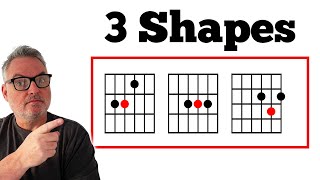
Do you know where your thirds are? In each CAGED shape, find the 3rd, then drop it to the 2nd or raise it to the 4th. The E, A and D shapes have one 3rd, so they're easy. The C and G shapes have two, which is why I use the Oasis G for G Sus4. The E Sus4 is the old Pinball Wizard one. A 9th never sounds wrong... it's the umami of chords.
How to practise this
Take one chord you know well, find its 3rd, then swap it for the 2nd and the 4th before putting the 3rd back again. Do this in each of the five CAGED shapes. Then play a simple change such as C to F and add a sus or add note to each chord to make the move prettier.
Free tool: Quick Tab Maker. Write out your sus and add versions of each CAGED shape so you can see where the 3rd moves.
Common questions
What is the difference between Sus2 and Add9?
A Sus2 has no 3rd (R 2 5), while an Add9 keeps the 3rd and adds the same note an octave up as the 9th (R 3 5 9).
What is the difference between Sus4 and Add11?
A Sus4 replaces the 3rd with the 4th (R 4 5). An Add11 keeps the full triad and adds the 4th, called the 11th (R 3 5 11).
Can sus chords be Major or minor?
No. A sus chord has no 3rd, so it is neither Major nor minor, which is why you can use it in place of either.
What is the difference between Add9 and Major 9?
An Add9 is a triad plus the 9th with no 7th. A Major 9 includes the Major 7th as well (R 3 5 7 9).

Get my free practice booklet
What to practise, in what order, and how to build a routine that works for you.
Keep learning


More ways to practise

Printable worksheets and matching ad free videos. Download, print and keep them beside you while you practise.
Explore PDF Club
The fretting hand techniques that make your playing sound musical, not stiff or mechanical.
Learn more
100 pages of blank chord boxes for writing, practising and teaching guitar.
Get your copy
Write, play and share your tabs, with playback so you can hear what you've written. Affiliate link.
Check it outWant my free Guitar Practice Made Simple booklet?
Know what to practise and make every session count. I'll send it straight to your inbox.
No spam. Unsubscribe any time.