
See the 5 Pentatonic Boxes as Two Small Shapes
Eyup FretHeads! Learning five pentatonic boxes as five big diagrams is a lot to hold in your head. Your brain likes small chunks, so let's break the boxes down into two little shapes that keep coming back.
| Box 1 | Frets 5 to 8 | E shape octave |
| Box 2 | Frets 7 to 10 | D shape octave |
| Box 3 | Frets 9 to 13 | C shape octave |
| Box 4 | Frets 12 to 15 | A shape octave |
| Box 5 | Frets 14 to 17 (or 2 to 5) | G shape octave |
Step 1: Start with box 1 and its roots
In A minor, box 1 sits at the 5th fret: 5 and 8 on the low E, 5 and 7 on the A, D and G strings, then 5 and 8 on the B and high E. Circle the roots. Because it starts on the E string, this is the E shape octave, and those roots are where your licks resolve. When you hit the root, the phrase is finished.
Step 2: Connect the boxes like Lego
These are two note per string patterns, so they stack like Tetris or Lego blocks. The back end of box 1 is the front end of box 2, and the back of box 2 is the front of box 3. The octaves follow the CAGED order: E shape, D shape, then C, A and G. Everything from the 12th fret up is just a repeat of the first 12.
Step 3: Find the two small shapes
Pentatonic means five notes: A C D E G, which is root, ♭3, 4, 5 and ♭7. In box 1, the A, D and G strings make a three string block, each string with two notes a tone apart. The B and high E strings make a two string block spanning four frets, with the root on the lower fret of the thinner string. That's the whole scale.
Step 4: Add the wraparound
The pentatonic really lives on five strings. Whatever you play on the high E string is repeated on the low E string, so I call that sixth string the wraparound. In box 1 the low E simply copies the high E. In box 5 you run out of strings, so the three string block carries on across onto the low E.
Step 5: Watch the G to B kink
In box 2 the three string block sits on the G, B and high E strings and looks bent. That's because the G and B strings are tuned a 3rd apart, not a 4th, so everything shifts up one fret as it crosses. Allow for that and it's the same block. Boxes 3 and 4 work the same way, with the root always in the same spot inside each piece.
How to practise this
Play box 1 in A and say every A as you hit it. Then find the three string block and the two string block in each box, noticing the kink on the G and B strings. Finish by improvising short phrases in each box and resolving them to the nearest A.
Free tool: Fretboard Note Trainer. Find every A on the neck quickly, so the roots inside each block jump out at you.
Common questions
What notes are in A minor pentatonic?
A, C, D, E and G: the root, ♭3, 4, 5 and ♭7.
How many pentatonic boxes are there?
Five. Together they cover the whole neck, and above the 12th fret they repeat.
How do the pentatonic boxes connect?
The back half of each box is the front half of the next, so neighbouring boxes share notes.
Why do pentatonic shapes bend on the B string?
The G and B strings are tuned a Major 3rd apart instead of a 4th, so shapes shift up one fret as they cross them.

Get my free practice booklet
What to practise, in what order, and how to build a routine that works for you.
Keep learning
 VIDEO LESSONPentatonic Elevator Triangles: Connect the Five Boxes
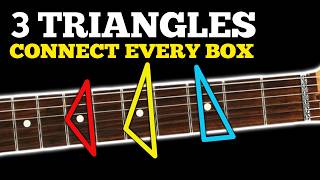 VIDEO LESSONHow to Escape Pentatonic Box 1 With Triangle Drills
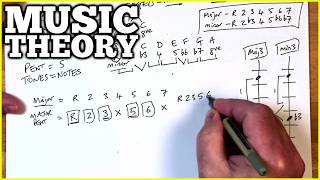 VIDEO LESSONWhere Pentatonic Scales Come From: Major and minor Formulas
More ways to practise

Printable worksheets and matching ad free videos. Download, print and keep them beside you while you practise.
Explore PDF Club
The fretting hand techniques that make your playing sound musical, not stiff or mechanical.
Learn more
100 pages of blank chord boxes for writing, practising and teaching guitar.
Get your copy
Write, play and share your tabs, with playback so you can hear what you've written. Affiliate link.
Check it outWant my free Guitar Practice Made Simple booklet?
Know what to practise and make every session count. I'll send it straight to your inbox.
No spam. Unsubscribe any time.