
Where to Play minor Pentatonic Box 1 in Any Major Key
Eyup FretHeads! If some of your minor pentatonic notes sound out of tune over a song, chances are box 1 is in the wrong place. Here's how to put it in the right position every time.
| G Major | Root at the 3rd fret | E minor pentatonic, open or 12th fret |
| A Major | Root at the 5th fret | F♯ minor pentatonic, 2nd fret |
| B♭ Major | Root at the 6th fret | G minor pentatonic, 3rd fret |
Step 1: Why box 1 sometimes clashes
Box 1 is the pattern everybody uses, from Stevie Ray Vaughan to Jimi Hendrix and Jimmy Page. Over a blues, putting it on the key's root works, so it's easy to assume it fits everything. Over a pop or rock song in a Major key, some notes will clash with the Major chords. You can bend your way out of a bum note, but there's a better answer.
Step 2: Understand the key
A key is a family of chords made from a parent Major scale. Using the Grid in G, the root of chord I is on the low E string at the 3rd fret, chord IV is on the A string at the 3rd fret and chord V is two frets above that. Those are your three Major chords. An equal and opposite L shape gives you the three minor chords, vi, iii and ii.
Step 3: Put the pentatonic on chord vi
This is literally the key to the key. Count through the chords to chord vi. In G that's E minor, and every note of E minor pentatonic belongs to the key of G, which is why it always sounds in tune. Octaves are like bookends: they hold the other notes in place, and you choose which books go between them.
Step 4: Use the shortcut
Find chord I on the low E string, the tonic, the note everything gravitates back to like a black hole. Then move down a tone and a semitone, three frets. In A, the root is at the 5th fret, so you drop to F♯ at the 2nd fret and play box 1 from there. Play it from the A instead and you'll hear the dissonance.
Step 5: The same shape is Major pentatonic
In that F♯ shape, start from the A your pinky plays on the 5th fret and you're playing A Major pentatonic. That makes sense, because you're in a Major key. Your minor blues licks turn into a Major blues sound, which is bright and optimistic. For unfamiliar keys like B♭, use the dots at 3, 5, 7 and 9 and the 12th fret to find your way.
How to practise this
Pick a Major key, find chord I on the low E string and drop three frets. Play box 1 from there over a progression in the original key and listen to how every note sits. Repeat in G, A and B♭, then play the same shape from the Major root for the Major pentatonic sound.
Free tool: Fretboard Note Trainer. Find the root of any key on the low E string quickly, so dropping three frets becomes automatic.
Common questions
Where do I play minor pentatonic in a Major key?
From chord vi, the relative minor, which is three frets below the Major root on the low E string.
What minor pentatonic fits the key of G?
E minor pentatonic, because E minor is chord vi in G Major.
Why does my minor pentatonic sound wrong?
If you play it from the root of a Major key over Major chords, its ♭3 and ♭7 clash with the key. Move it to chord vi.
Are Major and minor pentatonic the same shape?
Yes. The same box gives you F♯ minor pentatonic or A Major pentatonic depending on which note you treat as home.

Get my free practice booklet
What to practise, in what order, and how to build a routine that works for you.
Keep learning
 VIDEO LESSONPentatonic Elevator Triangles: Connect the Five Boxes
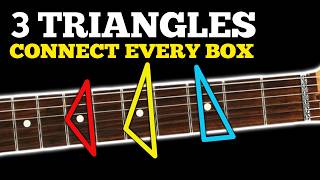 VIDEO LESSONHow to Escape Pentatonic Box 1 With Triangle Drills
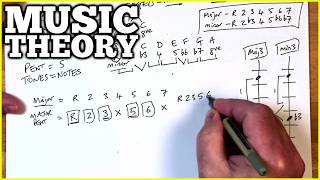 VIDEO LESSONWhere Pentatonic Scales Come From: Major and minor Formulas
More ways to practise

Printable worksheets and matching ad free videos. Download, print and keep them beside you while you practise.
Explore PDF Club
The fretting hand techniques that make your playing sound musical, not stiff or mechanical.
Learn more
100 pages of blank chord boxes for writing, practising and teaching guitar.
Get your copy
Write, play and share your tabs, with playback so you can hear what you've written. Affiliate link.
Check it outWant my free Guitar Practice Made Simple booklet?
Know what to practise and make every session count. I'll send it straight to your inbox.
No spam. Unsubscribe any time.