
Connect Blues Chords and Lead in a Dominant Blues in A
Eyup FretHeads! A lot of players see their blues chords as one thing and their pentatonic as something completely separate. This lesson joins them up, so your lead follows the A7, D7 and E7 of a 12 bar blues.
| I | A7 | A C♯ E G |
| IV | D7 | D F♯ A C |
| V | E7 | E G♯ B D |
| Dominant pentatonic over A7 | A B C♯ E G | R 2 3 5 ♭7 |
Step 1: Build the blues from the key
In A Major, chords I, IV and V are A, D and E. Extend them to 7th chords and the V is already dominant: that's why it's called the dominant. For a bluesy sound we turn I and IV into dominant 7ths as well, swapping the Major 7 for the ♭7. That gives you A7, D7 and E7, and the L7 grid lets you move I, IV and V to any key.
Step 2: Strip the chord to a shell
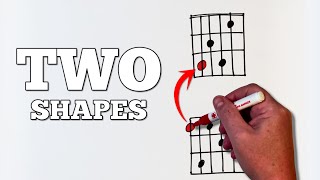
Play A7 as an E shape barre at the 5th fret. The 5th doesn't add any colour to the chord, and you don't need duplicate roots, so take them away. Keep the Major 3rd and the ♭7. Those two notes form a tritone, the devil's interval, and they hold the whole character of the dominant chord. You can add a 13th with your free pinky.
Step 3: Move the tritone through I IV V
From the A7 tritone, move the shape down a half step and you have D7. Move it up a whole step from there and you have E7. You can hear the harmony changing with just two fingers. Add one more note, the 5th, and you get a handy three string grip that looks just like a D shape, on the D G B or G B E string sets.
Step 4: Push strum and sliding pivot
For a push strum, start the chord one fret below where it lives and slide it into place as the pick moves through the strings. That's tension then release, like the train on the track. For the sliding pivot, keep your third finger on and slide it one fret to get between A7 and D7, instead of building the next chord from scratch.
Step 5: Let the chord show you the lead
The chord fragment tells you where the strong notes are, so you don't have to guess. Over A7 try the Major pentatonic, the minor pentatonic or a mix. Over D7 and E7 try the dominant pentatonic: R 2 3 5 ♭7. That Major 3rd is why it follows a dominant chord so well. Slide from the ♭3 into the Major 3rd for a big chunk of the blues sound.
How to practise this
Play a slow 12 bar in A using only the two note tritone shapes, then add the 5th to make the three string grips and try the push strum. Next, play one chord, answer it with a short lick built from the notes under your fingers, and move to the next chord. Leave space, and you don't need a backing track or strict tempo to do this.
Free tool: Metronome. Keep your 12 bar steady while you switch between the shell chords and your answering licks.
Common questions
What are the chords in a 12 bar blues in A?
A7 (I), D7 (IV) and E7 (V), all dominant 7th chords.
What is the dominant pentatonic scale?
Root, 2nd, Major 3rd, 5th and ♭7. Over A7 that gives A B C♯ E G, which outlines the dominant chord.
Can I change pentatonic scale with each chord in a blues?
Yes. Rather than staying in one scale for all 12 bars, you can follow each chord with Major, minor or dominant pentatonic ideas.
What notes make a shell chord for a dominant 7th?
The Major 3rd and the ♭7, which form a tritone. The root is often added; the 5th can usually be left out.

Get my free practice booklet
What to practise, in what order, and how to build a routine that works for you.
Keep learning


More ways to practise

Printable worksheets and matching ad free videos. Download, print and keep them beside you while you practise.
Explore PDF Club
The fretting hand techniques that make your playing sound musical, not stiff or mechanical.
Learn more
100 pages of blank chord boxes for writing, practising and teaching guitar.
Get your copy
Write, play and share your tabs, with playback so you can hear what you've written. Affiliate link.
Check it outWant my free Guitar Practice Made Simple booklet?
Know what to practise and make every session count. I'll send it straight to your inbox.
No spam. Unsubscribe any time.