
Blues in E: E7, A7 and B7 With Major and minor Blues
Eyup FretHeads! A lot of players learn blues chords and blues scales as two separate things. This lesson joins them up around E7, A7 and B7, so the chord and the lick come from the same place.
| I | E7 | E minor blues and E Major blues |
| IV | A7 | Major pentatonic House of Blues around A |
| V | B7 | Same House of Blues shape, moved up |
Step 1: Put the E minor blues around E7
Start with an open E7 and combine it with the E minor blues scale in the open position: 0 3 on the low E string, 0 1 2 on the A string, 0 2 on the D string and 0 2 on the G string, then slide up to the 4th fret. That little climb reveals another E7. If you know the D7 shape, move it up a whole step and you've got it.
Step 2: Turn the shape into a turnaround
That E7 shape on the top strings becomes the foundation of a turnaround. You don't have to play all of it. Use just the G and B strings, or one finger, or a single note, or slide into it. Lots of different ways of using the same idea, and they all keep you close to the chord.
Step 3: Add the E Major blues
Now it gets a bit more fruity. The E Major blues is the Major pentatonic with the ♭3 added. On the low E string it starts 0 2 3 4, and you can play the same idea on the thin E string. You don't have to add the ♭3, plain Major pentatonic is that My Girl sound. One move I like: go up the Major blues, come down the minor blues.
Step 4: Move to A7 and find the House of Blues
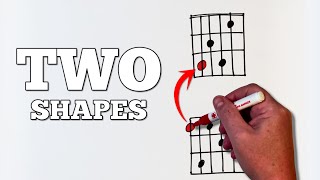
Chord IV is A7, and there are a few ways to play it, so look for the root, the Major 3rd and the ♭7 rather than one compulsory grip. Slide your first finger from the 2nd fret to the 5th to get a D shape idea. Those fingers form two thirds of the roof of the House of Blues: a triangle on the G and B strings and a rectangle on the B and E strings.
Step 5: Shift it all to B7
Move the A7 idea up a whole step for chord V, B7, and get your thumb over the top for the B root. Take a finger off and the House of Blues reveals itself again. Because these are dominant chords, the Major pentatonic sounds great over them, but you can switch to minor too. Now apply the same turnaround idea to each chord.
How to practise this
Loop a slow 12 bar in E and only use the E7 shape and its turnaround for the first few rounds. Then add the 0 2 3 4 Major blues idea going up and the minor blues coming down. Once that feels natural, find the House of Blues around A7 and B7 and play a short phrase over each chord change.
Free tool: Quick Tab Maker. Write down the turnaround and House of Blues shapes for each chord so you can practise them away from the video.
Common questions
What are the chords in a blues in E?
E7, A7 and B7, which are chords I, IV and V.
What is the difference between Major blues and minor blues?
The Major blues is the Major pentatonic with an added ♭3, which sounds sweeter. The minor blues is the minor pentatonic with an added ♭5, which sounds darker.
Can you play Major and minor pentatonic over the same blues?
Yes. Over dominant 7th chords, mixing the two is one of the most characteristic blues sounds.

Get my free practice booklet
What to practise, in what order, and how to build a routine that works for you.
Keep learning


More ways to practise

Printable worksheets and matching ad free videos. Download, print and keep them beside you while you practise.
Explore PDF Club
The fretting hand techniques that make your playing sound musical, not stiff or mechanical.
Learn more
100 pages of blank chord boxes for writing, practising and teaching guitar.
Get your copy
Write, play and share your tabs, with playback so you can hear what you've written. Affiliate link.
Check it outWant my free Guitar Practice Made Simple booklet?
Know what to practise and make every session count. I'll send it straight to your inbox.
No spam. Unsubscribe any time.