
A 12 Bar Rock Blues Riff in A for Jamming
Eyup FretHeads! If you get asked to jam and freeze, it helps to have one solid blues ready to go. This rock blues in A is great for warming up with a band, and you can loop it and solo over it.
| Bars 1 to 4 | A riff | Played four times |
| Bars 5 and 6 | D riff | Same idea moved up |
| Bars 7 and 8 | A riff | Back home |
| Bars 9 and 10 | E then D | Inverted power chord double stops |
| Bars 11 and 12 | Turnaround | Chromatic climb into E7 |
Step 1: Learn the double stops
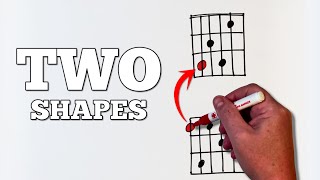
Hold a double stop with your third finger at the 7th fret on the G and B strings, then move to your index finger at the 5th fret. It follows the dots, so it's very hard to get lost. As you land on the 5th fret, pull down a little on the G string. That note is the ♭3, and pulling it makes it sound like it wants to go to the Major 3rd.
Step 2: Resolve and add the hammer on
Instead of going to the Major 3rd, resolve to the root, A, at the 7th fret of the D string. Then add a little hammer on: play the 7, then 5 and hammer on to 7. Between these bits, play the open A string twice, palm muted. To me it sounds a bit like School's Out and a bit like Sunshine of Your Love. Play that riff four times.
Step 3: Move it to D
For chord IV, move the whole idea up to D. The double stop now sits at the 12th and 10th frets on the G and B strings, with the same hammer on and group of three. Play that twice, then go back to the A riff twice. So far that's four bars of A, two bars of D and two bars of A.
Step 4: The last four bars
Start the last four bars on E with an inverted power chord double stop at the 14th fret on the A and D strings. I think of these like trumpets. Play around the ♭3 on the G string with a bit of vibrato, then 12 and 13. Take that same idea down a whole step for D. That covers two bars, and the last two are the proper turnaround.
Step 5: Learn the turnaround on its own
The turnaround is worth learning by itself, it's good for managing your fingers. Start on A at the 5th fret of the thin E string, then move to your first finger on the A string 4th fret and your middle on the 2nd fret, only using two fingers. Keep it swung, count 1 and 2 and 3 and 4 and, climb chromatically to the 6th fret and land on E7. It sounds like a train coming along.
How to practise this
Learn the A riff slowly, first with just the palm muted open A notes, then add the double stops, the pull and the hammer on. Practise the turnaround on its own with a swung count until it flows. Then play one full 12 bar cycle without stopping, record it into a looper and solo over the top.
Free tool: Metronome. Count the swung turnaround against a slow click so the rhythm stays steady when you join up all 12 bars.
Common questions
What are the chords in a 12 bar blues in A?
A, D and E, which are chords I, IV and V. In a rock blues you often play them as riffs rather than full chords.
What is a double stop on guitar?
Two notes played together, usually on neighbouring strings. They give you a fuller sound than single notes without a full chord.
What is a turnaround in blues?
It's the last two bars of the form, which lead you back round to the start, usually landing on chord V.
What does palm muting mean?
Resting the side of your picking hand lightly on the strings near the bridge, so the notes sound short and chunky.

Get my free practice booklet
What to practise, in what order, and how to build a routine that works for you.
Keep learning


More ways to practise

Printable worksheets and matching ad free videos. Download, print and keep them beside you while you practise.
Explore PDF Club
The fretting hand techniques that make your playing sound musical, not stiff or mechanical.
Learn more
100 pages of blank chord boxes for writing, practising and teaching guitar.
Get your copy
Write, play and share your tabs, with playback so you can hear what you've written. Affiliate link.
Check it outWant my free Guitar Practice Made Simple booklet?
Know what to practise and make every session count. I'll send it straight to your inbox.
No spam. Unsubscribe any time.