
Play Blues on Your Own: Shell Chords and Scales
Eyup FretHeads! Playing blues on your own can feel thin without a band or backing track. This lesson gives you an all in one framework: play a chord, answer it with a phrase, then move to the next chord.
| I | A7 | Major pentatonic, minor pentatonic, or both |
| IV | D7 | minor pentatonic is the safe choice |
| V | E7 | minor pentatonic is the safe choice |
| Any | Dominant pentatonic | R 2 3 5 ♭7 from the chord's own root |
Step 1: Find I, IV and V
Go somewhere new from somewhere you already know. Using the L7 Grid, find A on the low E string at the 5th fret: that's the tonic and the root of chord I. The root of IV, D, is on the A string at the same fret, and V, E, is a whole step above. In the blues all three become dominant 7ths. Major 7ths are for when you're with the lady of your dreams, 7ths for when she leaves you.
Step 2: Shrink them to shell chords
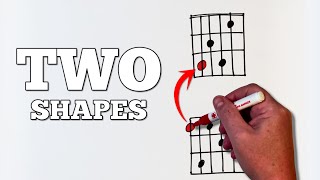
We don't want barre chords, we want something easy to launch from. Take the E shaped A7, chuck away the doubled notes and keep the root, 3rd and ♭7. That's a shell chord with only the money notes. For D7, drop from the A shape to the C shape and keep root, 3rd and ♭7 again. Move the same shell up a whole step for E7.
Step 3: Use a sliding anchor
Watch your third finger. I call it a sliding anchor. Lift the other two fingers, slide the third finger back a fret, and put the two fingers back down to get the next chord. Those shapes move to any key: down to G, up to B, wherever you like. Keep your first and third fingers ready, because those are the fingers you launch into lead from.
Step 4: Choose a scale for each chord
Over A7 I favour the Major pentatonic first, with the House of Blues shape, then switch to the minor. It's like someone buying you a new garden shed: happy, until you realise you've got to assemble it yourself. Over D7 and E7, the minor pentatonic is the safe choice. Mixing Major and minor stops you sounding the same every time.
Step 5: Add the dominant pentatonic
There's also a dominant pentatonic: root, 2, Major 3rd, 5, ♭7. It matches the dominant chord, and I like the tritone it gives you, which sounds a bit rockabilly. Build it from the root of whichever chord you're on, so from A over A7, D over D7 and E over E7. It's not what you can do, it's what you can get away with.
Step 6: Bend the right notes
Don't bend the root, save it for ending phrases. In the Major pentatonic, bend the 2nd up a half step to the ♭3. When you mix in the minor sound, push the ♭3 towards the Major 3rd: that's the mooing cow bend. Leave it slightly short of pitch and it sounds sadder. Remember Son House: the blues is as many bars as it needs to be, so take your time.
How to practise this
Play the A7, D7 and E7 shell chords through a 12 bar in A, using the third finger as a sliding anchor. Then after each chord, play one short phrase from the matching scale before moving on. Once that feels good, try the dominant pentatonic over each chord and move the whole thing to G.
Free tool: Quick Tab Maker. Tab out your three shell chords and a phrase for each one, so you have your own little blues to build on.
Common questions
Can you play blues guitar without a band?
Yes. Move between small shell chords and short lead phrases, so you are your own rhythm and lead player.
What scale do you play over a blues in A?
The A minor pentatonic works over the whole blues. Over the A7 chord you can also use the A Major pentatonic, and mixing the two gives more colour.
What is the dominant pentatonic scale?
A five note scale with the formula root, 2, 3, 5, ♭7. It matches the sound of a dominant 7th chord.
What notes are in a shell chord?
Usually the root, 3rd and ♭7. These carry the sound of a dominant 7th chord without needing a barre.

Get my free practice booklet
What to practise, in what order, and how to build a routine that works for you.
Keep learning


More ways to practise

Printable worksheets and matching ad free videos. Download, print and keep them beside you while you practise.
Explore PDF Club
The fretting hand techniques that make your playing sound musical, not stiff or mechanical.
Learn more
100 pages of blank chord boxes for writing, practising and teaching guitar.
Get your copy
Write, play and share your tabs, with playback so you can hear what you've written. Affiliate link.
Check it outWant my free Guitar Practice Made Simple booklet?
Know what to practise and make every session count. I'll send it straight to your inbox.
No spam. Unsubscribe any time.