
Mix a Dominant 7th Arpeggio into minor Pentatonic
Eyup FretHeads! If your minor pentatonic licks are starting to sound the same over a bluesy A7 chord, this little arpeggio shape adds a brighter, bluesier colour you can switch in and out of.
| A | Root | Low E string, 5th fret |
| C♯ | Major 3rd | A string, 4th fret |
| E | 5th | A string, 7th fret |
| G | ♭7 | D string, 5th fret |
| A | Root | D string, 7th fret |
Step 1: Learn the triangle
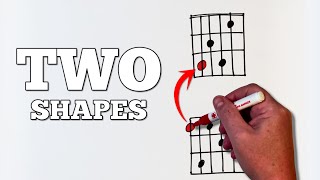
Start with the root on the 5th fret of the low E string, then play the 4th and 7th frets of the A string. That little triangle shape outlines the A Major triad: root, 3rd and 5th. It sits right inside the area where you already play A minor pentatonic box 1, so you're not moving anywhere new.
Step 2: Extend it with the ♭7
A dominant chord is a Major chord with a ♭7, so add the G on the 5th fret of the D string and land on the root again at the 7th fret. Now you have root, 3rd, 5th, ♭7 and root. That's your A7 arpeggio, and there's a free PDF diagram of it with the video.
Step 3: Know what the two shapes share
The root, 5th and ♭7 are in both the minor pentatonic and the arpeggio, so bending from the ♭7 up to the root works in either. The difference is the 3rd: the pentatonic has the ♭3 (C) and the arpeggio has the Major 3rd (C♯). That's why this only works over the dominant chord. Over a minor chord the Major 3rd will clash.
Step 4: Switch between them
Put an A7 on a loop and play a normal minor pentatonic lick, then drop into the arpeggio. Try starting a phrase on the ♭7 instead of the root, which is where everybody starts. Move from the ♭3 up to the Major 3rd, or from the 3rd into the 4th, and resolve on the root. You can even slip in the ♭5 as a little chromatic passing note.
How to practise this
Loop an A7 chord or use a backing track and play four bars of minor pentatonic, then four bars of the arpeggio. Once that feels easy, switch in the middle of a phrase, aiming for the ♭3 to 3 move and finishing on the root.
Free tool: Quick Tab Maker. Write out your own licks that switch from the pentatonic into the arpeggio, so you can see where the ♭3 turns into the 3rd.
Common questions
What notes are in an A7 arpeggio?
A, C♯, E and G: the root, Major 3rd, 5th and ♭7.
Can you play a dominant 7th arpeggio over a minor chord?
Not really. Its Major 3rd clashes with the minor 3rd in the chord, so save it for dominant 7th chords.
What is the difference between A minor pentatonic and an A7 arpeggio?
Both contain A, E and G. The pentatonic adds C and D, while the arpeggio has C♯, the Major 3rd.
Why does mixing Major and minor 3rds sound bluesy?
Moving between the ♭3 and the Major 3rd over a dominant chord is a core blues sound, which is why players slide or bend between them.

Get my free practice booklet
What to practise, in what order, and how to build a routine that works for you.
Keep learning


More ways to practise

Printable worksheets and matching ad free videos. Download, print and keep them beside you while you practise.
Explore PDF Club
The fretting hand techniques that make your playing sound musical, not stiff or mechanical.
Learn more
100 pages of blank chord boxes for writing, practising and teaching guitar.
Get your copy
Write, play and share your tabs, with playback so you can hear what you've written. Affiliate link.
Check it outWant my free Guitar Practice Made Simple booklet?
Know what to practise and make every session count. I'll send it straight to your inbox.
No spam. Unsubscribe any time.