
Jazzy Blues Turnaround in A with Three Note Shapes
Eyup FretHeads! If your blues fizzles out at the end, a turnaround gives it a big finish. This one is a bit jazzy, and the small version doubles as a set of target notes for your solos.
| A to A7 | Chord I picks up its ♭7 | Starts pulling the turnaround forward |
| F7 | C7 shape with the root at the 8th fret of the A string | Sits a half step above E7 |
| E7♯9 | Chord V with the ♯9 | Small version: 3rd, ♭7 and ♯9, no root |
| Altered E7 | One finger moves from the E7♯9 | More tension before home |
| A13 | Back home on chord I | A compact, rich finish |
Step 1: Play it with full chords
Start on a full A Major, then A7. Use your 3rd finger to slide up a whole step and add your first finger to make a G shape, which gives a Hendrix style sound. Then jump to a C7 shape with its root on the 8th fret of the A string, which is F7. From there play an E7♯9, add an altered dominant and end on A13.
Step 2: Slim it down to three notes
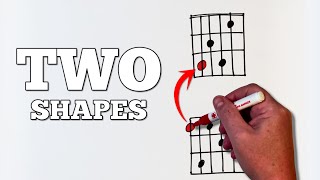
Now play each chord with just three fingers. The A shape is small with no barring. The A7 shape might look like a D shape, and if you dropped it onto the G, B and E strings you'd be right; I've just kept the money notes. For the Hendrix move I play an A shape across with one finger, then roll it over into a three finger F7 shell chord.
Step 3: Strip the E7♯9 to its colour notes
For the E7♯9 I get rid of the root and keep the 3rd, ♭7 and ♯9. It's almost like an A shape, inverted and flipped. To get the altered dominant, just pull your 3rd finger back. Then go back to the diagonal shape for A13. It looks like the 7♯9, but it isn't.
Step 4: Use the shapes as target notes
These little shapes aren't just for rhythm. If you're wailing away in minor pentatonic at the end of a blues and want something just outside it, aim for the notes of each chord as it happens. That's what I call the chord of the moment. Land on its notes and your solo follows the turnaround instead of ignoring it.
How to practise this
Play the full chord version slowly until the changes are smooth, then learn the three note version one chord at a time. Finally, loop the turnaround and solo over it, landing on a note from each small shape as the chord changes.
Free tool: Quick Tab Maker. Write out both versions of the turnaround so you can keep the fingerings in front of you while you learn them.
Common questions
What is a turnaround in blues?
A short chord sequence in the last bars of a blues that leads your ear back to the start of the form.
What notes are in an E7♯9 chord?
E, G♯, B, D and the ♯9, which sounds the same as G. The small version keeps just G♯, D and the ♯9.
Why go from F7 to E7 in a blues in A?
F7 sits a half step above E7, so it slides neatly into chord V and adds tension before resolving to A.
What is a shell chord?
A slimmed down chord that keeps only the most important notes, usually the 3rd and 7th, sometimes with the root.

Get my free practice booklet
What to practise, in what order, and how to build a routine that works for you.
Keep learning


More ways to practise

Printable worksheets and matching ad free videos. Download, print and keep them beside you while you practise.
Explore PDF Club
The fretting hand techniques that make your playing sound musical, not stiff or mechanical.
Learn more
100 pages of blank chord boxes for writing, practising and teaching guitar.
Get your copy
Write, play and share your tabs, with playback so you can hear what you've written. Affiliate link.
Check it outWant my free Guitar Practice Made Simple booklet?
Know what to practise and make every session count. I'll send it straight to your inbox.
No spam. Unsubscribe any time.