
Slow 12 Bar Blues in A With Two Easy Chord Shapes
Eyup FretHeads! Big chord grips can make blues feel like hard work. This slow blues in A uses two small shapes, the open bass strings and a sliding movement, so it's super accessible and sounds lovely.
| Bars 1 to 4 | A | Small D7 style shape over open A, slide down |
| Bars 5 and 6 | D | One finger at the 7th fret over open D, slide down |
| Bars 7 and 8 | A | Back to the A shapes |
| Bar 9 | E | One finger at the 9th fret over open E, slide down |
| Bar 10 | D | Back to the 7th fret |
| Bars 11 and 12 | A | Optional E7♯9 shock chord at the end |
Step 1: Learn the first shape for A
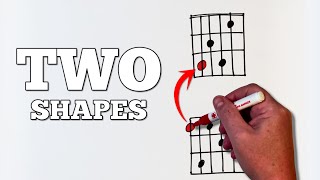
If you can play a D7, you can play this. It's the same shape on the D, G and B strings at the 7th and 6th frets, and it's really an A6. Play the open A string twice, strum the little shape, then slide it down two frets. I call that second sound the 9. Technically it's a dominant 7th with a sus2, but let's not argue about it.
Step 2: Use the open strings
This blues lets you use the open strings, so that's where the picking comes in. Open A twice, strum, slide down. Isn't that dreamy? It sounds a bit Hawaiian to me, as if I should have a hat on with pineapples and mangoes. Add a bit of wobble on the end if you like. Four bars of that gives you the start of the 12 bar.
Step 3: One finger for D
For chord IV, use one finger across the G, B and E strings at the 7th fret. Play the open D string twice as the bass note, and mute the low E and A strings with your palm and thumb. Strum the shape, then slide it down two frets, the same 6 to 9 movement as before. Play two bars of D, then two bars of A.
Step 4: Move it up for E
Use the L7 Grid to find chord V, which is E. Play the open E string twice and move the one finger idea up two frets to the 9th fret, then slide it down. The last four bars are one bar of E, one bar of D, and two bars of A. You don't even need to move that finger much between E and D.
Step 5: Add the shock chord
Six bars of A in a row can get a bit dull, so at the end I put in a shock chord with a lot of tension: the Hendrix chord, E7♯9. Play it in place of the last bit of A, and when you go back to the top it feels really resolved. It's optional, but it's a great way to make the turnaround stand out.
How to practise this
Start by playing just the A section until the open string, strum and slide feel smooth. Then add the D shape with careful muting of the low strings, and the E shape two frets higher. Play the full 12 bars slowly with the E7♯9 at the end, then loop it and try soloing over it.
Free tool: Metronome. Set a slow tempo so the open bass notes, strum and slide land evenly in every bar.
Common questions
What chords are in a 12 bar blues in A?
A, D and E, which are chords I, IV and V.
What is the order of a 12 bar blues?
A common form is four bars of I, two of IV, two of I, one of V, one of IV and two of I.
What is the Hendrix chord?
It's the 7♯9 chord, such as E7♯9, a dominant 7th with a raised 9th that sounds tense and bluesy.
Can beginners play slow blues?
Yes. Small three note shapes over open bass strings give you a full sound without big chord grips.

Get my free practice booklet
What to practise, in what order, and how to build a routine that works for you.
Keep learning


More ways to practise

Printable worksheets and matching ad free videos. Download, print and keep them beside you while you practise.
Explore PDF Club
The fretting hand techniques that make your playing sound musical, not stiff or mechanical.
Learn more
100 pages of blank chord boxes for writing, practising and teaching guitar.
Get your copy
Write, play and share your tabs, with playback so you can hear what you've written. Affiliate link.
Check it outWant my free Guitar Practice Made Simple booklet?
Know what to practise and make every session count. I'll send it straight to your inbox.
No spam. Unsubscribe any time.