
Chord Tone Soloing Made Easy With 5R3 Triad Shapes
Eyup FretHeads! Ever been soloing happily in a scale when a strange chord comes along and suddenly everything sounds wrong? Chord tone soloing is how you get over that, and you don't need to memorise the whole fretboard to do it.
| Around the 3rd | One fret down: minor 3rd. One fret up: perfect 4th | Two frets down: 2nd (replace the 3rd for sus2 or sus4) |
| Around the Root | One fret down: Major 7. Two frets down: ♭7 | One fret up: ♭2. Two frets up: Major 2nd |
| Around the 5th | One fret down: ♯4 or ♭5. Two frets down: perfect 4th | One fret up: ♭6. Two frets up: Major 6th |
Step 1: Target the action chord
Scales and licks work until a chord comes along that doesn't fit. That's where chord tones come in. I call the chord happening right now the action chord, because now is the only time the action happens. Harmony is tension and release, consonance and dissonance. Instead of only thinking about the key, listen to the current chord and aim for its notes.
Step 2: Learn the Interval Seesaw
Draw out the intervals from the Root: minor and Major 2nds, minor and Major 3rds, the perfect 4th, the ♯4 or ♭5, the perfect 5th, minor and Major 6ths, minor and Major 7ths, and the octave. The 4th, 5th and octave sound consonant. The tritone sits right in the middle of the octave, which is why I call it the Interval Seesaw.
Step 3: Find 5R3 in your E, A and D shapes
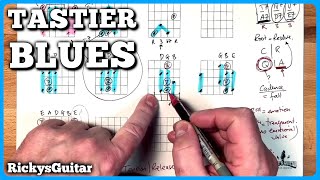
Play an open E Major chord and look at the three fretted notes: the 5th, the Root and the 3rd. That's a second inversion triad. The A shape and the D shape give you 5R3 under three fingers too, on the next string sets up. These are your North Stars. Once you know where the Root, 3rd and 5th are, you can find everything else from them.
Step 4: Change the 3rd for new sounds
The 3rd decides Major or minor. Lower it one fret and Major becomes minor. Move it up to the perfect 4th and you get sus4, or down to the 2nd for sus2. If the 3rd is replaced it's a suspension. If the 3rd stays and you add the note, it's an add chord. Try all of these on the E, A and D shapes.
Step 5: Map the notes around the Root and 5th
One fret below the Root is the Major 7, a half step. Two frets below is the ♭7, a whole step. Around the 5th you'll find the ♯4 or ♭5 just below, and the ♭6 and Major 6th just above. Lower the octave Root of an E shape and you can build E Major 7 and E7 in the same way.
Step 6: Move it and make music
5R3 is positionless: move the E or A shape version to any fret and the same relationships hold. Over a chord, starting on the Root can sound too settled, so try a Major 7 or a 6th for colour, then resolve to a chord tone. Move from the E shape to the D shape and into the A shape as the track plays, and mix it with the scales you already know.
How to practise this
Draw the Interval Seesaw, then play the 5R3 shapes inside your E, A and D chords and name each note as Root, 3rd or 5th. Over a single backing chord, target only those three notes, then add one neighbouring interval at a time and listen to the tension and release. Take one shape, one string and one interval at a time.
Free tool: Fretboard Note Trainer. Learn the root notes on every string so you can drop a 5R3 shape onto any chord quickly.
Common questions
What is chord tone soloing?
Targeting the notes of the chord being played at that moment, mainly the Root, 3rd and 5th, so your solo follows the harmony instead of just the key.
What is a 5R3 triad?
A second inversion triad, with the 5th at the bottom, then the Root, then the 3rd. You can find one under three fingers in the open E, A and D chord shapes.
What is the difference between a sus chord and an add chord?
In a sus chord the 3rd is replaced by the 2nd or 4th. In an add chord the 3rd stays and the extra note is added.
Where is the ♭7 in relation to the Root?
It's a whole step (two frets) below the Root on the same string. The Major 7 is a half step (one fret) below.

Get my free practice booklet
What to practise, in what order, and how to build a routine that works for you.
Keep learning



More ways to practise

Printable worksheets and matching ad free videos. Download, print and keep them beside you while you practise.
Explore PDF Club
The fretting hand techniques that make your playing sound musical, not stiff or mechanical.
Learn more
100 pages of blank chord boxes for writing, practising and teaching guitar.
Get your copy
Write, play and share your tabs, with playback so you can hear what you've written. Affiliate link.
Check it outWant my free Guitar Practice Made Simple booklet?
Know what to practise and make every session count. I'll send it straight to your inbox.
No spam. Unsubscribe any time.