
The Chords Hidden Inside Your Pentatonic Boxes
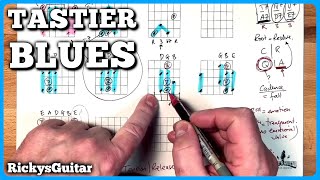
Eyup FretHeads! Pentatonic boxes and chord shapes are often learnt separately, but they live on the same fretboard. In this lesson I point out the chords hiding in each box, so you always know where to play.
| Box 1 (5th fret) | A minor: E minor shape | C Major: G shape |
| Box 2 | A minor: D minor shape | C Major: E shape |
| Box 3 | A minor: C minor shape | C Major: D shape |
| Box 4 | A minor: A minor shape | C Major: C shape |
| Box 5 | A minor: G minor shape | C Major: A shape |
Step 1: Find the roots with octave shapes
Start with A minor pentatonic box 1, with the root at the 5th fret of the low E string. Plot the roots and you get an E shaped octave, so an E minor shaped A minor chord sits inside the box. Then follow CAGED along the neck: after E comes D, then C, A and G. Use the octave shapes to find each new root. This is why you need to know them.
Step 2: Map the five minor shapes
Box 1 holds the E minor shape, box 2 the D minor shape, box 3 the C minor shape, box 4 the A minor shape and box 5 the G minor shape. Box 5 also sits an octave lower, which hooks it back into box 1. It is a completely movable system, so slide everything along and it works for G minor, B minor or whatever key you want.
Step 3: Play the practical ones
The E minor and A minor shapes are the barre chords you already use. The D minor shape works as a barre or as a little three note idea. The C minor and G minor shapes are awkward as full chords, but don't write them off. Play the C minor shape as an arpeggio, root, ♭3, 5 and root, and pull small triads out of the G minor shape.
Step 4: Same notes, C Major
A minor pentatonic and C Major pentatonic share the same notes, so you don't need new boxes, you just start on a different note. Box 1 of A minor is box 5 of C Major, and it holds a G shape. Then come the E, D, C and A shapes as you go up. Where the minor shapes had a ♭3, the Major shapes have a Major 3rd.
Step 5: Pull out useful voicings
The full G shape is a bit of a monkey, but the A shape intersects it, and you can play a lovely first inversion chord from there. The E and A shapes are your bog standard barre chords. The D and C shapes are better played as notes and partial shapes than full grips. Now every pentatonic box has a chord to go with it, Major or minor.
How to practise this
Choose one box, find every root, and name the CAGED octave shape it belongs to. Play the chord or a three note triad from those notes, then a short phrase in the box that ends on a chord tone. Work through all five boxes in A minor, then again thinking in C Major.
Free tool: Fretboard Note Trainer. Finding roots quickly is the first step to seeing the chord shape inside each box.
Common questions
Which chord shapes are inside the minor pentatonic boxes?
In order from box 1, the E, D, C, A and G minor CAGED shapes.
Are A minor pentatonic and C Major pentatonic the same?
They use the same five notes, A C D E G, but resolve to different roots, so the chords you target change.
Why connect CAGED shapes to pentatonic boxes?
It shows you the chord tones inside each box, so you can target roots, 3rds and 5ths and mix chords into your lead playing.

Get my free practice booklet
What to practise, in what order, and how to build a routine that works for you.
Keep learning



More ways to practise

Printable worksheets and matching ad free videos. Download, print and keep them beside you while you practise.
Explore PDF Club
The fretting hand techniques that make your playing sound musical, not stiff or mechanical.
Learn more
100 pages of blank chord boxes for writing, practising and teaching guitar.
Get your copy
Write, play and share your tabs, with playback so you can hear what you've written. Affiliate link.
Check it outWant my free Guitar Practice Made Simple booklet?
Know what to practise and make every session count. I'll send it straight to your inbox.
No spam. Unsubscribe any time.