
Solo From E, A and D Chord Shapes With Major Pentatonic
Eyup FretHeads! If your solos live up in the box patterns but your chords live down in E, A and D, you are doing twice the work for half the results. Here those three shapes become your solo navigation system.
| E shape | Cluster on the A, D and G strings | Root on the D string |
| A shape | Cluster on the D, G and B strings | Root on the G string |
| D shape | Cluster on the G, B and E strings | Root on the B string |
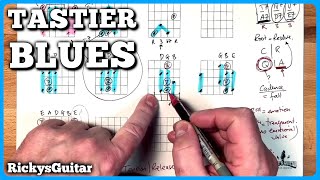
Step 1: Find 5 R 3 in each shape
Look at the fingers you actually hold down. In the E shape, the three finger cluster is 5, root, 3. The A shape has the same cluster, and so does the D shape. In each one the middle note is the root. I call it 5R3, and it is your North Star, because these shapes move all around the neck and the root moves with them.
Step 2: Leg, rectangle, long leg
From the root, go up a whole step for the leg, then draw the rectangle with your fingers for the 3rd, 5th and 6th. That is what most people show you. I add a longer leg: a minor 3rd, a step and a half step, up from the 6th takes you to the root an octave higher. Now you have landed on a root again, so you can play the same pattern from there.
Step 3: Start with the E shape
In the open position you can launch from the open E string. Move the E shape up, say to G at the 3rd fret, and you lose that open string, so launch from the root in the middle of the cluster instead, on the D string. The pattern runs up the D and G string pair and lands you on another root, so you get the same idea twice with only one pattern memorised.
Step 4: Compensate in the A shape
The root of the A shape sits on the G string, so the pattern crosses from the G string to the B string. Play the plain rectangle there and it sounds wrong. Move the B string notes up one fret to compensate for the tuning, and the rectangle becomes a little rhomboid. It can feel like your fingers are crossing over, but it connects the E and A shapes neatly.
Step 5: The D shape and the whole neck
The D shape on the G, B and E strings is completely movable: shift it up a step and it is E, then F, then F♯. Its root sits on the B string, and because B to E is a perfect 4th, the rectangle goes back to normal. Link the E, D and A shapes together and these three chord shapes carry you all the way up the neck.
Step 6: Add colour notes
Fill in the rectangle with the ♭3 and the Major pentatonic becomes the Major blues scale, with more personality. Using the long leg, the Major 7 sits one fret below the octave root and the ♭7 two frets below. Use the Major 7 over chords I and IV. Over chord V use the ♭7, just as you lift a finger to turn an E shape into E7.
How to practise this
Pick a key, say A, and find the E, A and D shapes for it up the neck. For each one, find the middle note of the 5 R 3 cluster, then play leg, rectangle and long leg from it, slowly. Once that feels natural, add the ♭3, then try the Major 7 and ♭7 versions.
Free tool: Fretboard Note Trainer. Knowing your notes makes it quick to find each shape and its root in any key.
Common questions
How do I connect chords to my guitar solos?
Find the root note inside the chord shape you are playing and start your scale pattern from it, so the solo grows out of the chord.
Which scale fits a Major chord?
The Major pentatonic from the chord's root works well, and adding the ♭3 gives a Major blues sound.
Where is the root note in an E shape barre chord?
On the low E string, the thin E string, and in the middle of the 5 R 3 cluster on the D string.
When should I use a ♭7 instead of a Major 7?
Use the ♭7 over a dominant chord such as chord V, and the Major 7 over chords I and IV when you want a Major 7 sound.

Get my free practice booklet
What to practise, in what order, and how to build a routine that works for you.
Keep learning


More ways to practise

Printable worksheets and matching ad free videos. Download, print and keep them beside you while you practise.
Explore PDF Club
The fretting hand techniques that make your playing sound musical, not stiff or mechanical.
Learn more
100 pages of blank chord boxes for writing, practising and teaching guitar.
Get your copy
Write, play and share your tabs, with playback so you can hear what you've written. Affiliate link.
Check it outWant my free Guitar Practice Made Simple booklet?
Know what to practise and make every session count. I'll send it straight to your inbox.
No spam. Unsubscribe any time.