
How to Jam in Any Key With the Relative minor Trick
Eyup FretHeads! Somebody tells you the song is in B Major, your brain panics and you worry about looking daft. This lesson gives you a simple system for finding the key and playing in it.
| A Major | F♯ minor | Landmark at the 2nd fret |
| B Major | G♯ minor | Landmark at the 4th fret |
| C Major | A minor | Landmark at the 5th fret |
| D Major | B minor | Landmark at the 7th fret |
Step 1: Find the key with the A shape
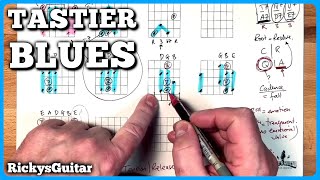
Play an A shape chord and look at the three notes on the same fret on the D, G and B strings: 5th, root and Major 3rd. That is a second inversion triad. Move it up a whole step and it is B, a half step more and it is C. It works all the way up the neck, so whatever key someone calls, you can find it.
Step 2: Move it a string for the relative minor
Shift those same three notes one string towards the floor, onto the G, B and E strings. Now you have the ♭3, the 5th, and the root on the thin E string, which is the relative minor. A Major gives you F♯ minor, B Major gives G♯ minor and D Major gives B minor. In the Major key it is chord vi; from the minor side the Major is ♭III.
Step 3: Play box 1 both ways
The relative minor root is also on the thick E string, which is where box 1 of the minor pentatonic starts. Then use my hand of rock trick. Start box 1 on your index finger and you are in the minor pentatonic. Start on your pinky and the same shape becomes the relative Major pentatonic, the My Girl lick. One shape covers both keys.
Step 4: Know the chord behind each landmark
Three notes can feel a little bare, so put them in context. The Major landmark comes from the A shape, and with your third finger arched over you get a lovely first inversion, A over C♯, which is handy if barre chords are a struggle. The minor landmark is really an E minor shape. A minor and C Major share two notes, which is why they blend so nicely.
Step 5: Find your roots for resolving
Break box 1 up with my 3 and 2 method: a group of three on the A, D and G strings, then the big rectangle of minor 3rds on the E strings. For the minor, the root sits in the group of three. For the Major, it is the middle of the 5 R 3 cluster. Know where those roots live, because that is where you resolve your phrases.
Step 6: Add the tritone for the full scale
When you have more to say, add two notes to make a seven note scale. In A minor and C Major those are B and F, a tritone apart, and they sit inside the big rectangle. Played from the index finger that gives you the natural minor, or Aeolian; from the pinky it is the Major scale, do re mi. Mix the chilled pentatonic with that extra tension.
How to practise this
Have a friend call out a Major key, or pick one at random. Find it with the A shape landmark, move it one string to find the relative minor, then play box 1 from your index finger and again from your pinky. End every phrase on the root of the key you are thinking in.
Free tool: Fretboard Note Trainer. Naming notes on the thin E string quickly lets you read off the relative minor straight away.
Common questions
How do I find the relative minor of a Major key?
It starts on the 6th note of the Major scale. On guitar, move the three note A shape landmark one string towards the floor and read the root on the thin E string.
What is the relative minor of C Major?
A minor. Both keys use the same notes, with no sharps or flats.
Can I use the same pentatonic box for Major and minor?
Yes. Relative Major and minor pentatonics share their notes, so one box works for both; you just change which root you resolve to.
What is the relative minor of G Major?
E minor.

Get my free practice booklet
What to practise, in what order, and how to build a routine that works for you.
Keep learning



More ways to practise

Printable worksheets and matching ad free videos. Download, print and keep them beside you while you practise.
Explore PDF Club
The fretting hand techniques that make your playing sound musical, not stiff or mechanical.
Learn more
100 pages of blank chord boxes for writing, practising and teaching guitar.
Get your copy
Write, play and share your tabs, with playback so you can hear what you've written. Affiliate link.
Check it outWant my free Guitar Practice Made Simple booklet?
Know what to practise and make every session count. I'll send it straight to your inbox.
No spam. Unsubscribe any time.