
Solo Over C and G Chord Shapes With Major Pentatonic
Eyup FretHeads! If your guitar life is strumming C down to G and then panic sliding into a scale box somewhere, this is for you. We'll solo right on top of those chords using their root notes.
| C shape | A string, 3rd fret | Launch on the A and D strings |
| C shape | B string, 1st fret | Launch on the B and E strings |
| G shape | Low E string, 3rd fret | Launch on the E and A strings |
| G shape | Open G string | Rhomboid across the G and B strings |
Step 1: Think like a fish
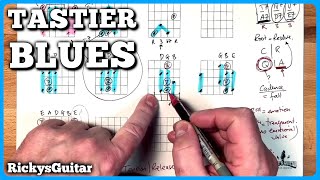
If you want to swim like a fish, first you must think like a fish. So find the roots. In the C shape, the note under your third finger is C, the root that names the chord, and there is another C an octave higher on the B string. The G shape is very rooty: there is a G on the low E string, the open G string and the thin E string.
Step 2: Make the shape movable
Playing the whole C shape higher up is tricky, so take just part of it, the root and the 3rd. Move it up two frets and it is D, then E, F, G and A. You can even lift your first finger and just follow the root, while you almost hallucinate the full shape behind it. That root is your doorway into the pattern.
Step 3: Leg, rectangle, minor 3rd
Stay on the A and D string pair. From the root go up a whole step for the leg, then draw the rectangle for the 3rd, 5th and 6th. That is where most people stop. Instead, go up a minor 3rd from the 6th and you land on the root an octave higher. It moves you to a position you might not be thinking about, and that is where the cool stuff happens.
Step 4: Use the other roots
Launch the same pattern from the higher C on the B string. B and E are tuned a perfect 4th apart, so it works perfectly and gives you a higher voice from the same pattern. From the G on the low E string it runs up to another G, so you can repeat it. From the open G string, compensate: the rectangle shifts up a fret on the B string and becomes a rhomboid.
Step 5: Add the ♭3 and the 7ths
Fill in the rectangle with the ♭3 and the Major pentatonic becomes the Major blues scale. The long leg also shows you the 7ths: the Major 7 sits one fret below the octave root and the ♭7 two frets below. Use the Major 7 over chords I and IV, and the ♭7 over a dominant chord like G7 for that bluesy, country sound.
How to practise this
Strum C for a bar, then play the pattern from its root on the A string; strum G and play it from the root on the low E string. Once that flows, try the higher voices from the C on the B string and the open G, then add the ♭3, and finally the ♭7 over a G7.
Free tool: Metronome. Keep a steady beat as you switch between strumming the chord and playing the pattern.
Common questions
What scale can I solo with over C and G chords?
In the key of C, C Major pentatonic fits both chords, and you can also play the Major pentatonic from each chord's own root.
Where are the root notes in an open G chord?
On the 3rd fret of the low E string, the open G string and the 3rd fret of the thin E string.
What is the Major blues scale?
The Major pentatonic with an added ♭3: R 2 ♭3 3 5 6.
Why does the pattern change on the B string?
The G and B strings are tuned a Major 3rd apart rather than a perfect 4th, so notes on the B string move up one fret to keep the same shape of intervals.

Get my free practice booklet
What to practise, in what order, and how to build a routine that works for you.
Keep learning



More ways to practise

Printable worksheets and matching ad free videos. Download, print and keep them beside you while you practise.
Explore PDF Club
The fretting hand techniques that make your playing sound musical, not stiff or mechanical.
Learn more
100 pages of blank chord boxes for writing, practising and teaching guitar.
Get your copy
Write, play and share your tabs, with playback so you can hear what you've written. Affiliate link.
Check it outWant my free Guitar Practice Made Simple booklet?
Know what to practise and make every session count. I'll send it straight to your inbox.
No spam. Unsubscribe any time.